
Spain 2025: Real Estate Market, Rental Yields and Taxes Explained
If you are thinking about buying property in Spain in 2025, the numbers look attractive at first glance: prices are rising, demand is strong and gross rental yields are solid by European standards.
But behind this growth there is a complex mix of regulation, taxes and tenant-friendly rules that every investor needs to understand before choosing a city or a strategy.
Let’s walk through the key facts step by step.
1. Where the Spanish Property Market Is in 2025
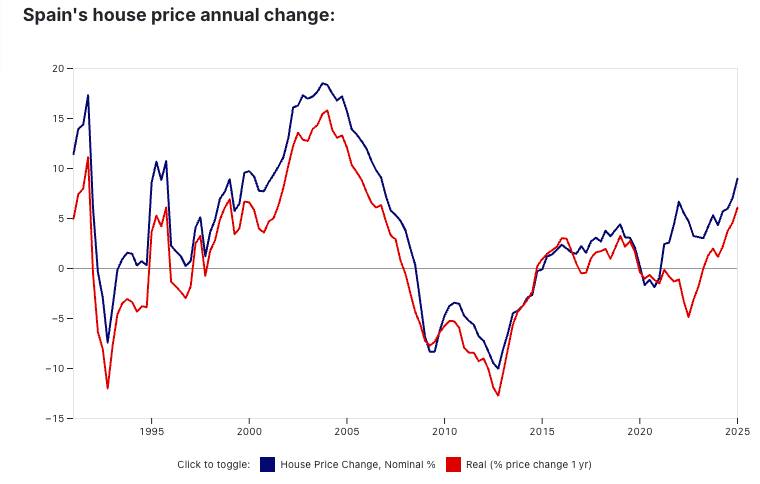
Spain’s housing market is currently in a clear growth phase.
- According to Idealista, prices in Q1 2025 are up +11.16% year-on-year, or +8.71% after adjusting for inflation.
- For comparison:
- 2024: +11.21%
- 2023: +8.16%
- According to the Bank of Spain (Q4 2024), prices are up +7.05% nominal, which is about +4.58% in real terms.
Growth is broad-based:
- All 19 autonomous communities have seen price increases.
- Leaders by growth are regions like Andalusia, Aragon, Navarre and the Valencian Community, with annual increases in the range of roughly +12–13%.
Activity in the market is also strong:
- Transactions:
- 2024: about 642,000 sales (around +10% year-on-year).
- January 2025: another +11% compared to the previous year.
- Construction:
- 2024 housing starts: 112,000 (+14.5%).
- Completions: 86,600 (+7.6%).
In short, Spain in 2025 is not a stagnant market. It is active, expanding and still attracting both local and foreign buyers.
2. Average Property Prices per m² in Spain (2025)
Prices vary significantly between cities and regions. Here are reference average prices per square meter:
- Madrid – €5,316 / m²
- Palma de Mallorca – €5,283 / m²
- Barcelona – €4,808 / m²
- Málaga – €3,419 / m²
- Andalusia (regional average) – €2,609 / m²
- Alicante – €2,417 / m²
- Seville – €2,315 / m²
- Tenerife – €2,314 / m²
- Valencia (city/region reference) – €2,180 / m²
- Murcia – €1,627 / m²
- Córdoba – €1,532 / m²
For investors, this price spread is important: it shows where the market is already premium (Madrid, Palma, Barcelona) and where there may still be relatively “cheaper entry points” with solid demand (Valencia, Alicante, Murcia, some parts of Andalusia).
3. Rental Yields in Spain (Before Costs and Taxes)
Gross rental yields are attractive by Western European standards, but they are far from uniform.
Approximate gross yields (before any expenses or taxes):
- National average: about 5.4–5.6%
- Barcelona: around 7.2%
- Murcia: about 6.6%
- Valencia: around 6.1%
- Madrid: about 5.0%
- Málaga: about 5.0%
- Marbella: about 4.7%
This means that on paper you can often find:
- Higher yields in secondary cities or less “glamorous” locations.
- Lower, but still reasonable yields in premium areas like Marbella or central Madrid where capital values are higher.
However, these are gross figures. Once you factor in maintenance, community fees, insurance, vacancy and especially taxes, the picture changes significantly.
4. Key Legal and Market Changes Investors Must Know
2025 is not only about rising prices. It is also about structural shifts in rules and regulations.
Golden Visa Through Property: Ended in April 2025
- The well-known Golden Visa route through real estate investment was abolished on 3 April 2025.
- Existing applications and current holders are not affected, but new investors cannot use property as a fast-track residency route.
If your main goal is residence, you now need to look at other options (digital nomad visa, non-lucrative visa, work-based residence, etc.), not just a large property purchase.
New Index for Rent Updates: IRAV Replaces CPI
From 1 January 2025, the IRAV index replaces CPI for rent indexation:
- The idea is to smooth out sharp jumps in rent updates.
- This is part of a broader pro-tenant approach, limiting how quickly landlords can increase rents in many cases.
You cannot simply raise rent by inflation spikes like in earlier years. Indexation is now more controlled and predictable for tenants.
LAU: Spain’s Rental Law Is Mostly Tenant-Friendly
The Ley de Arrendamientos Urbanos (LAU) remains clearly pro-tenant in many aspects:
- Right to extend long-term contracts up to:
- 5 years (if the landlord is an individual), or
- 7 years (if the landlord is a legal entity / company).
- Deposit:
- For residential rentals: typically 1 month of rent.
- For commercial rentals: often 2 months.
- Evictions for non-payment are slow:
- In practice, a process can take 6–12 months or more, depending on the court and the specific case.
For a landlord, this means that legal enforcement is not quick. Non-paying tenants are a real risk that must be priced into your strategy and emergency reserves.
Short-Term Rentals: Strict Rules and Licensing
Short-term holiday rentals (tourist licenses) are heavily regulated, especially in areas under housing pressure:
- Cities and regions like Barcelona, Madrid and the Balearic Islands apply strict rules and require tourist licenses.
- Controls are increasing, and many municipalities are limiting new licenses or tightening enforcement.
If your business model is based on Airbnb-style rentals, you must check local rules in detail. In some cities, obtaining a new license is extremely difficult or practically impossible in central areas.
5. Key Taxes for Non-Resident Property Investors in Spain
Now to the part that can make or break your net return: taxation.
Below is a simplified overview, especially relevant for non-residents.
Tax on Rental Income (Non-Residents)
For rental income, Spain distinguishes between EU/EEA and non-EU/EEA investors:
- EU/EEA citizens:
- Tax rate: 19% on net income.
- You can deduct allowable expenses (maintenance, community fees, some costs) before calculating tax.
- Non-EU/EEA citizens:
- Tax rate: 24% on gross income (no deduction of expenses).
- This hits net yield hard, because every euro of rent is taxed, even if your costs are high.
Example: if your gross yield is 6%, a 24% tax on gross rent alone already reduces it to about 4.56%, before you pay any other costs.
There is also IRPF: for non-residents, the basic rate is often 24%, but for EU/EEA residents it is 19%, provided there is information exchange between the countries.
Capital Gains Tax (CGT)
When you sell your Spanish property as a non-resident:
- Capital Gains Tax (CGT) is 19% on the gain.
- For properties purchased before 31 December 1994, special reducing coefficients can apply, which lower taxable gains for long-held assets.
Additionally:
- The buyer must withhold 3% of the declared purchase price and pay it directly to the tax authorities.
- This functions as an advance payment against your CGT.
- You may later reclaim part of it or pay the difference, depending on the final calculation.
Municipal Tax on Land Value Increase (IIVTNU)
The Impuesto sobre el Incremento de Valor de los Terrenos de Naturaleza Urbana (IIVTNU), often called the municipal plusvalía, is:
- Applied to the increase in the cadastral value of the land over the period you owned the property (up to 20 years).
- Set by each municipality, which:
- Applies a coefficient to the cadastral value.
- Defines a tax rate that can go up to around 30%.
This tax is separate from national CGT and must be considered in your exit strategy.
Property Tax (IBI)
The Impuesto sobre Bienes Inmuebles (IBI) is an annual property tax:
- Typical reference rates:
- Around 0.4% of cadastral value in cities.
- Around 0.3% in rural areas.
- Each municipality defines its own exact rate within a legal range.
The cadastral value is often lower than market value, but in prime areas it can still be substantial.
Wealth Tax (Impuesto sobre el Patrimonio – IP)
Wealth tax is applied in several regions, with significant regional differences:
- Progressive rates are roughly between 0.2% and 3.5% of net assets.
- Allowances, thresholds and possible reliefs are regional, so the burden varies between, for example, Madrid, Catalonia, Valencia, Andalusia and others.
- For non-residents, the “60% limit” (which caps the total combined burden of income and wealth tax in some resident scenarios) generally does not apply.
That means your wealth tax bill can be less protected than for some residents.
6. Investment Conclusions: Is Spain Attractive in 2025?
Putting all this together, what does it mean for you as an investor?
On the positive side:
- Spain is in a growth phase in 2025, with solid price appreciation over recent years.
- Gross rental yields are quite high for Western Europe, especially in cities like Barcelona, Valencia or Murcia.
However, there are three major areas of friction:
- Law clearly favors tenants
- Evictions are slow and complex, even in clear non-payment cases.
- Rent increases are more strictly regulated via the new IRAV index and rental rules.
- Short-term rentals are tightly controlled
- Many profitable tourist areas require licenses that are hard to obtain and closely supervised.
- Ignoring local tourism rules can lead to fines or forced cessation of activity.
- Tax burden, especially for non-EU investors, is heavy
- For non-EU/EEA investors, the flat 24% tax on gross rent alone can reduce a 6% nominal yield to around 4.56% even before operating costs.
- CGT, IIVTNU, IBI and potential wealth tax all eat into returns further.
Because of this, Spain in 2025 is best seen as:
- A diversification play within the European Union.
- A market where you combine lifestyle (own use, second home, relocation plans) with long-term capital preservation and moderate net yield, rather than pure high-yield speculation.
If you are ready to accept stricter regulation and higher taxes in exchange for stability, liquidity and the quality-of-life factor, Spain can still be a very attractive part of your long-term portfolio. The key is to model your returns after taxes and legal realities, not just the headline yield or price chart.


