# Spain Tax Refunds in 2026: How Long Does AEAT Have to Pay?
The Spanish annual income-tax campaign is over, your Renta declaration shows a refund, and now comes the frustrating part: waiting for the money.
For the 2025 tax year, Spain's Renta campaign ended on June 30, 2026.
Many taxpayers receive their refunds quickly. Others wait weeks or months while Agencia Tributaria, commonly referred to as AEAT or Hacienda, processes the return and checks information reported by employers, banks, investment platforms and other third parties.
A slow refund does not automatically mean that you are being audited.
Spanish law gives the Tax Agency a defined period to process a refund, and taxpayers also have rights when that period is exceeded.
This guide explains how the system works, what the common status messages mean, when interest may become payable and why the amount arriving in your bank account can sometimes be smaller than the refund shown on your tax return.
Quick answer
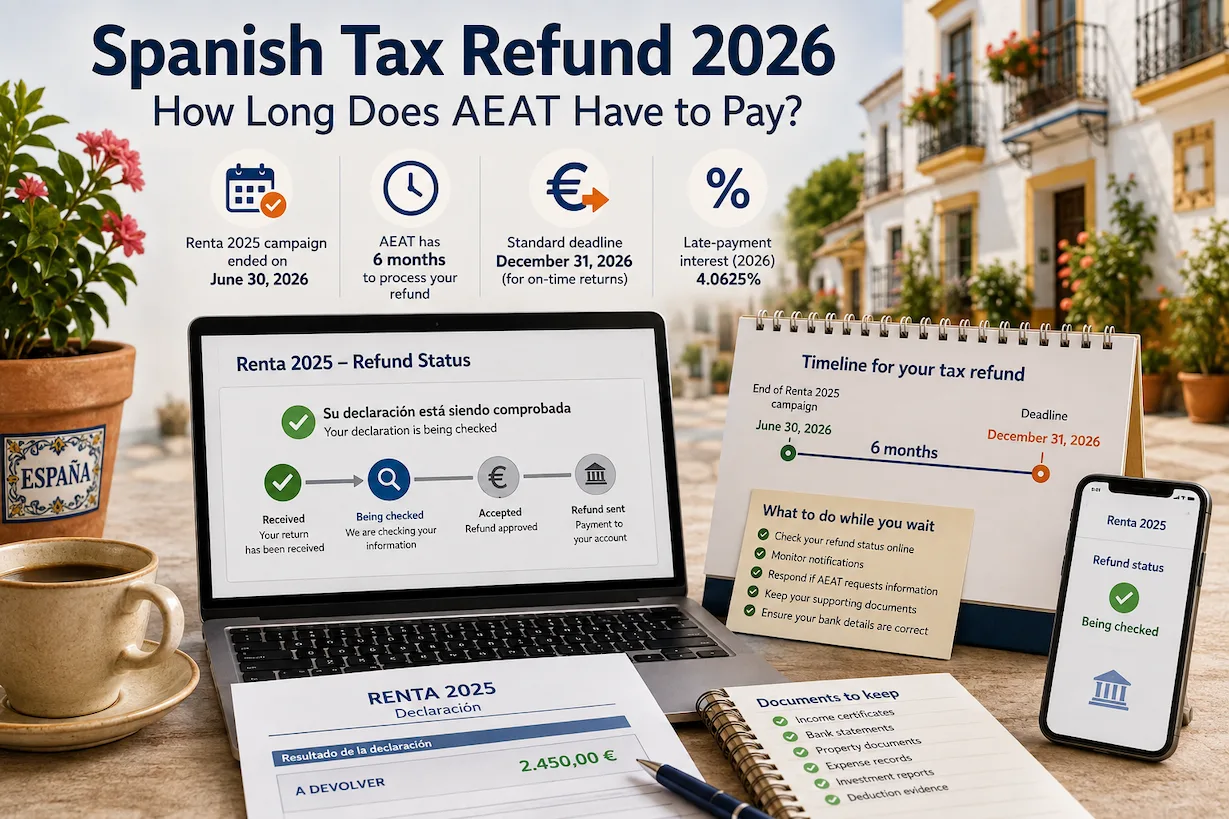
If your Spanish income-tax return shows an amount **a devolver**, Agencia Tributaria generally has six months from the end of the normal filing period to process the refund or initiate the appropriate verification procedure.
For the Renta 2025 campaign, the normal filing period ended on June 30, 2026.
If you submitted the return after the normal deadline, the six-month period is measured from the date you actually submitted it.
If the refund is delayed beyond the statutory period for reasons attributable to the Tax Administration, tax late-payment interest is added automatically. You do not normally need to submit a separate request for that interest.
For 2026, the tax late-payment interest rate currently shown by Agencia Tributaria is 4.0625%, subject to any later change in the State Budget legislation.
Key takeaways
* The Renta 2025 campaign ended on June 30, 2026.
* AEAT does not have to refund everyone immediately after a declaration is filed.
* The statutory rule is a six-month processing period.
* A return filed late starts its own six-month period from the filing date.
* A declaration showing "being checked" does not necessarily mean a full tax audit.
* AEAT may compare your declaration with information received from employers, banks and other reporting parties.
* Existing public debts managed for collection can sometimes be offset against a refund.
* Not every traffic fine, Social Security debt or local tax is automatically deducted by AEAT in every situation.
* If AEAT delays payment beyond the legal period for reasons attributable to the Administration, interest is added automatically.
* The currently applicable 2026 tax late-payment interest rate is 4.0625%, unless subsequently changed by legislation.
* You can monitor your Renta refund online through Renta WEB and through the AEAT mobile application.
* Never ignore electronic or postal notifications from Agencia Tributaria.
1. What does a Spanish tax refund actually mean?
When you file your annual Spanish income-tax return, or declaración de la Renta, the calculation compares your final Personal Income Tax liability with amounts already paid or withheld during the year.
These may include withholding from:
* Salary
* Pension income
* Professional income
* Certain investment income
* Other payments subject to withholding
The calculation can also incorporate:
* Personal and family circumstances
* State deductions
* Autonomous-community deductions
* Capital income
* Rental income
* Capital gains and losses
* Economic activities
* Other taxable income
If the amount already paid exceeds the final tax due, your declaration can produce a result **a devolver**.
That means you are requesting that Agencia Tributaria return the calculated excess.
A refund is not an instant payment order
One important distinction is that submitting a return with a refund does not mean AEAT has immediately accepted every figure in the declaration.
The requested refund can still be checked.
The Tax Agency may verify whether the declaration is consistent with information already in its systems before approving payment.
2. How long does Agencia Tributaria have to refund you?
Spanish income-tax rules give the Tax Administration six months.
For a return submitted within the normal filing period, that period is calculated from the end of the official filing deadline.
The Renta 2025 campaign ended on June 30, 2026.
Therefore, taxpayers should think in terms of a **six-month statutory window from the end of June**, rather than assuming that every refund must arrive within a few weeks of filing.
What if you filed in April?
Suppose you submitted your return on April 10, 2026.
The six-month statutory period does not normally begin on April 10 simply because you filed early.
For an on-time return, the legal period is linked to the end of the normal campaign.
This means filing very early may result in an early refund, but it does not shorten AEAT's statutory six-month processing window.
What if you filed late?
This works differently.
If the declaration was submitted after the normal filing period ended, the six-month period is calculated from the date of the late filing.
For example, a return filed in September does not receive the same late-December reference point as a return filed properly during the campaign.
Does AEAT normally take six months?
No.
The six months represent the legal processing framework, not the standard waiting time for every taxpayer.
Many refunds are paid much earlier.
Agencia Tributaria began issuing refunds only days after the 2026 campaign opened.
Simple returns containing information that closely matches AEAT's existing tax data can often move quickly.
More complicated declarations may take longer.
3. Why are some tax refunds paid faster than others?
No two declarations are identical.
A straightforward employee return may be easier to verify than a declaration involving multiple countries, rental properties, investment sales and self-employment.
Factors that can lead to additional checking include:
* Multiple employers
* Employment abroad
* Foreign income
* Foreign investment accounts
* Capital gains
* Cryptocurrency transactions
* Sale of property
* Rental property
* Short-term rental income
* Self-employment
* Business activity
* Large deductions
* Unusual deductions
* Changes in family circumstances
* Differences between taxpayer data and third-party reporting
* Amended declarations
* Significant refund amounts
None of these factors automatically means that something is wrong.
They simply create more information that may need to be matched or verified.
4. How to check the status of your Spanish tax refund
You do not have to call Agencia Tributaria simply to find out whether the refund has been processed.
The status can be checked online.
The main route is through the Renta WEB service in the electronic headquarters, or Sede Electrónica, of Agencia Tributaria.
You can also access refund information through the official AEAT mobile application.
Ways to identify yourself
Depending on the service, taxpayers may access their Renta file using:
* Cl@ve
* Digital certificate
* Electronic DNI
* Renta reference number
* eIDAS identification for eligible EU users
After entering your Renta file, look for the **Estado de Tramitación**, or processing status.
5. What do the Renta status messages mean?
The wording displayed in your file gives an indication of where the declaration is in the process.
Several messages are commonly encountered.
"Su declaración se está tramitando"
This broadly means:
**Your declaration is being processed.**
It is an ordinary status.
The declaration has been received and remains in the processing workflow.
There is generally no reason to panic simply because this message remains visible for some time.
"Su declaración está siendo comprobada"
This means:
**Your declaration is being checked.**
This message understandably makes some taxpayers nervous.
However, it does not automatically mean that you are undergoing a full tax inspection.
The Tax Agency may simply be comparing information contained in your return with data already reported to it.
That may include information from:
* Employers
* Banks
* Pension providers
* Investment institutions
* Property records
* Other reporting entities
The check may ultimately result in the refund being approved exactly as requested.
Declaration processed and refund accepted
Once the appropriate checks have been completed and the refund is considered correct, the status changes again.
The taxpayer may then see that the declaration has been processed by the tax-management authorities and that the requested refund is considered compliant.
The system can subsequently indicate when the refund is being issued.
6. "Being checked" is not the same as a tax audit
This distinction is important.
Many taxpayers see **Su declaración está siendo comprobada** and immediately assume Hacienda is conducting a major investigation.
That conclusion is premature.
Spanish tax administration includes different levels of checking and review.
A routine automated or management-level comparison of declared information is not the same thing as a formal tax inspection.
Why might a routine check occur?
Imagine your employer reported one salary figure while your declaration contains another.
Or your bank reported investment income that is absent from your return.
The system may need to establish why the information differs.
Sometimes the explanation is perfectly legitimate.
For example:
* A figure was duplicated in third-party data.
* Income belongs to a different tax category.
* A deduction is valid but not automatically visible to AEAT.
* The taxpayer corrected information in the draft.
* Ownership percentages changed.
* Foreign tax information arrived separately.
The important point is to be able to support what you filed.
7. Should you use VERIFICA?
Older tax guidance and online discussions frequently mention a tool called **VERIFICA** that could appear in certain refund files where AEAT had detected discrepancies.
You should not assume that every Renta 2025 refund file will display a VERIFICA option.
The current AEAT guidance for the 2025 campaign directs taxpayers primarily to their Renta WEB file, their processing status and the available actions within that file.
What should you do instead?
Open your current Renta 2025 file and review the options actually offered by Agencia Tributaria.
If AEAT presents a proposed correction, verification option or request for information:
* Read the proposed change carefully.
* Compare it with your filed return.
* Check your supporting documents.
* Do not accept a change merely to obtain the refund faster.
* Respond within any stated deadline.
Accepting an incorrect adjustment simply because it appears to accelerate processing can cost far more than waiting for the matter to be reviewed correctly.
8. Do not ignore Agencia Tributaria notifications
One of the most avoidable tax problems is failing to respond to an official communication.
A delayed refund may sometimes be connected with information AEAT needs from the taxpayer.
The Tax Agency may request:
* A document
* Proof of a deduction
* Clarification of income
* Information concerning a property
* Evidence of a transaction
* Confirmation of tax residence
* Other supporting information
Electronic notifications matter
Depending on your status and how you interact with the Administration, notices may be available electronically.
Do not rely exclusively on waiting for a traditional paper letter.
Periodically check:
* Your AEAT file
* Electronic notifications
* Your registered contact information
* Messages from your tax adviser
Missing a deadline can turn a simple clarification into a more difficult problem.
9. Can Hacienda reduce your refund because you owe money?
Yes, in certain circumstances.
Spain has a legal mechanism known as **compensación**, or offsetting.
A recognized payment owed to a taxpayer can be used to extinguish qualifying debts owed by that same taxpayer.
For example:
You are entitled to a €2,000 tax refund.
You also have a qualifying enforceable public debt of €600 that is being collected through the relevant system.
If the debt is offset against the refund, you could receive the remaining €1,400.
The important correction
It is too broad to say:
"Hacienda automatically deducts every traffic fine, Social Security debt and unpaid IBI from every tax refund."
That is not an accurate universal rule.
The key question is whether the debt is legally available for offset and is being managed or collected through a system that can apply the credit.
Agencia Tributaria explains that offsets are commonly applied against tax refunds and that payments from other public bodies can also be used against debts managed by AEAT.
What about traffic fines?
A traffic fine may eventually become an enforceable public debt, but the collection authority and procedural stage matter.
Do not assume every recently issued parking or traffic fine will instantly reduce your income-tax refund.
What about IBI?
IBI is a municipal property tax.
Whether an unpaid local tax affects another public payment depends on the collection arrangements and legal stage of the debt.
Again, the existence of a debt does not mean every government computer automatically deducts it from every refund.
What happens if the refund is larger than the debt?
Where an authorized offset occurs and the refund credit exceeds the debt, the remaining difference is paid to the taxpayer.
10. What happens when AEAT takes longer than six months?
Spanish law protects taxpayers against certain excessive administrative delays.
If the six-month period expires and the refund has not been ordered for reasons attributable to the Tax Administration, late-payment interest is applied.
The taxpayer does not normally have to file a special claim asking Hacienda to calculate that interest.
It is added automatically.
When does interest start?
Interest begins from the day after the applicable six-month period expires.
It continues until the date on which payment of the refund is ordered.
What amount receives interest?
The interest is calculated on the refund amount ultimately approved by Agencia Tributaria.
That amount could be:
* The same refund you originally requested, or
* A different amount resulting from a verification procedure
11. What is the 2026 late-payment interest rate?
The current tax late-payment interest rate used by Agencia Tributaria for 2026 is:
**4.0625% per year**
This is more precise than describing the rate simply as 4.06%.
AEAT's 2025 Renta manual states that 4.0625% continues to apply in 2026 until a new State Budget law enters into force and potentially establishes a different rate.
That qualification matters.
Tax rates should always be checked against the rule in force during the actual delay period.
Example
Imagine an approved refund of €3,000 becomes subject to late-payment interest.
The annual rate is not simply added as a €121.88 bonus regardless of the delay.
Interest is calculated according to the amount and the actual period for which statutory late-payment interest accrues.
A delay of a few weeks therefore produces considerably less interest than a full year.
12. Who is responsible for the delay matters
The automatic interest rule applies when the failure to issue the refund within the statutory period is attributable to the Tax Administration.
That distinction can matter.
For example, the situation may be different where processing cannot progress because the taxpayer:
* Failed to provide requested documentation
* Did not respond to a notification
* Supplied incomplete information
* Created another procedural delay
This is another reason to monitor your tax file rather than simply waiting until the end of the year.
13. Can AEAT refund you and check the return later?
A refund being paid does not necessarily mean the tax return can never be reviewed again.
Tax authorities retain their legal verification and assessment powers within the applicable limitation periods.
A taxpayer should therefore keep the records supporting the declaration even after the refund arrives.
These can include:
* Salary certificates
* Bank statements
* Property records
* Rental contracts
* Expense records
* Investment reports
* Sale documentation
* Foreign tax records
* Deduction evidence
* Family documentation
Do not throw away supporting documents simply because the money reached your account.
14. Common reasons a refund can be delayed
A refund may take longer because of:
* A discrepancy with tax data
* A large refund
* Property income
* Foreign income
* Investment transactions
* Self-employment
* Missing information
* A corrected declaration
* A requested deduction requiring evidence
* Existing debts
* Bank-account problems
* Manual review
* A formal verification procedure
A delay alone does not tell you which reason applies.
Your online file is the best starting point.
15. Check the bank account used for the refund
Refunds are generally made by bank transfer to the account indicated in the declaration.
Check that:
* The IBAN is correct.
* The account remains open.
* You are the account holder where required.
* Your banking details have not changed.
The AEAT application and Renta services can provide options to view and, in appropriate circumstances, modify the IBAN connected with the refund before payment has been ordered.
A correct tax return can still encounter a practical payment problem if the bank details are wrong.
16. What should you do if nothing changes for months?
Start by checking the electronic file.
Do not assume that calling immediately will accelerate a return that remains legally within the normal processing period.
Step 1: Check the status
Access Renta WEB or the AEAT application and read the exact processing message.
Step 2: Check notifications
Make sure Agencia Tributaria has not requested information.
Step 3: Review your declaration
Pay particular attention to:
* Foreign income
* Rentals
* Capital gains
* Deductions
* Employment data
* Bank income
* Family information
Step 4: Compare with AEAT tax data
Identify any obvious difference between what third parties reported and what you declared.
A difference is not automatically an error, but you should know why it exists.
Step 5: Check the refund IBAN
Make sure the payment account is still valid.
Step 6: Review debts
If you have unpaid public debts, investigate whether a compensation or collection procedure is affecting the payment.
Step 7: Respond to any request
If AEAT asks for evidence, answer within the required period.
17. When should you contact a tax professional?
A straightforward employee return generally does not require a specialist simply because the refund is taking several months.
Professional advice becomes more valuable when the return includes:
* Income from several countries
* Change of tax residence
* Beckham Law or impatriate regime
* Foreign pensions
* Stock-option compensation
* Company ownership
* Self-employment
* Cryptocurrency
* Foreign investment accounts
* Rental property
* Tourist rental
* Sale of Spanish property
* Sale of foreign property
* Significant capital gains
* Complex family deductions
* Large refund
* Formal notification from Agencia Tributaria
The purpose of professional review is not to "make Hacienda pay faster."
It is to make sure that the declaration is defensible if AEAT asks why a particular tax treatment was used.
Frequently asked questions
How long does Spain have to pay my income-tax refund?
Agencia Tributaria generally has six months from the end of the normal filing period for an on-time return.
If the declaration was submitted after the normal deadline, the six-month period is calculated from the filing date.
When did the Renta 2025 campaign finish?
The 2025 income-tax campaign ended on June 30, 2026.
The campaign began on April 8, 2026.
Does AEAT have until December 31 to pay?
It is better to describe the legal rule accurately rather than relying on a simplified calendar statement.
The statute gives AEAT six months from the end of the filing period for an on-time return.
For Renta 2025, that reference point is the June 30, 2026 campaign deadline.
I filed in April. Does the six months start in April?
Normally no, when the return was filed within the regular campaign.
The statutory period is linked to the end of the normal filing deadline.
What if I filed after June 30?
For a late-filed declaration, the six-month period runs from the filing date.
Does "Su declaración está siendo comprobada" mean I am being audited?
Not necessarily.
It means the declaration is being checked.
That can involve routine comparison with information held by Agencia Tributaria and does not automatically mean a full tax inspection.
Can Hacienda change the amount of my refund?
Yes.
If verification determines that the correct refund differs from the amount requested, the Administration can adjust the result through the applicable procedure.
You should be notified of the relevant action and rights.
Will Hacienda automatically pay interest if the refund is very late?
When the statutory requirements are satisfied and the delay is attributable to the Tax Administration, late-payment interest is applied without the taxpayer having to request it separately.
What is the late-payment interest rate in 2026?
The current tax late-payment interest rate shown by Agencia Tributaria for 2026 is 4.0625%, subject to a later legislative change.
Can tax debts be deducted from my refund?
Yes, qualifying debts can be offset against recognized credits such as tax refunds.
However, it is misleading to assume every fine or local debt is automatically deducted in every case.
The type of debt, collection authority and procedural stage matter.
Can I track my refund from my phone?
Yes.
The official AEAT application includes access to the processing status of Renta 2025 declarations.
Will calling Hacienda make my refund arrive faster?
Usually, simply asking for the status does not change the legal processing order.
Contacting AEAT is more useful when:
* A notification is unclear
* Information is missing
* The online status indicates action is required
* The statutory processing period has been exceeded
* There is a payment problem after a refund was issued
Spanish tax refund checklist
After submitting your declaration
* Save the PDF of the filed return.
* Save the filing confirmation.
* Confirm the declared refund amount.
* Check the IBAN.
* Keep supporting documents.
While waiting
* Check Renta WEB periodically.
* Monitor electronic notifications.
* Review the exact processing status.
* Do not panic solely because the declaration is being checked.
* Respond quickly if AEAT requests documents.
If the refund is delayed
* Confirm when the six-month statutory period ends in your case.
* Check whether you filed late.
* Review possible discrepancies.
* Check for recognized public debts.
* Confirm that the bank account remains valid.
* Keep copies of all correspondence.
If AEAT proposes a change
* Read the proposal carefully.
* Compare it with the original declaration.
* Review your evidence.
* Calculate the financial effect.
* Do not accept simply because you want the refund faster.
* Obtain professional advice when the issue is material or complex.
Final thoughts
Waiting for a Spanish tax refund can be frustrating, particularly when someone you know received theirs in a few days while your declaration remains under review for months.
But different processing times do not necessarily indicate a problem.
Agencia Tributaria has a legally defined period to process refund claims, and some declarations require more verification than others.
The most important things are to understand the timeline, monitor the electronic file and respond to any communication promptly.
Remember the key points:
* The Renta 2025 campaign ended June 30, 2026.
* AEAT generally has a six-month statutory processing window.
* "Being checked" does not automatically mean a tax audit.
* Public debts can affect a refund in qualifying cases.
* Delays attributable to the Administration can generate automatic late-payment interest.
* The current 2026 tax late-payment interest rate is 4.0625%, subject to legislative change.
* Good records are your best protection when a declaration contains complex income or deductions.
Spanish tax administration often requires patience.
But patience should be combined with monitoring.
Check the file, read the notifications and know what you declared.
That is far better than simply waiting for a bank transfer and hoping everything is fine.
Source notes
This article was prepared from a supplied summary concerning Spanish income-tax refunds and then checked against current official information from Agencia Tributaria.
The following points were clarified during verification:
* The legal rule is a six-month period rather than a simple universal "December 31 deadline."
* For Renta 2025, the normal campaign ended on June 30, 2026.
* The current 2026 tax late-payment interest rate is 4.0625%, subject to a later State Budget change.
* Compensación can apply to recognized refunds and debts, but not every type of public fine or local debt should be described as automatically deductible in every case.
* Current AEAT guidance directs taxpayers to Renta WEB, the refund-processing status and the AEAT application; a specific VERIFICA option should not be promised for every taxpayer or every file.
Tax procedures, interest rates and digital services can change. Always verify the current position through Agencia Tributaria before acting.
Important note
This article is for general educational purposes only.
It is not individual Spanish tax, legal, accounting or financial advice.
Tax treatment depends on the taxpayer's circumstances, filing date, income, deductions, debts and any verification procedure opened by Agencia Tributaria.